
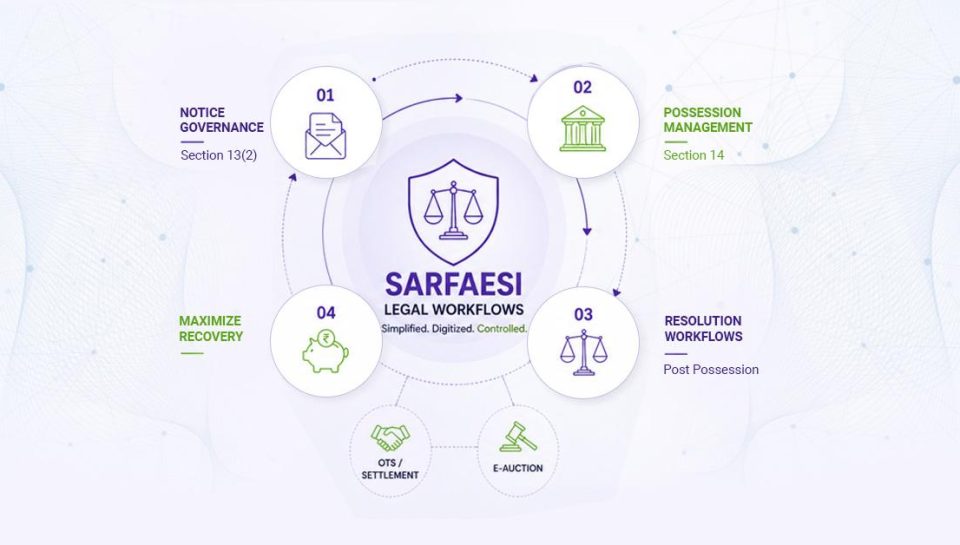
Managing Non-Performing Assets (NPAs) in the Indian Financial Services sector requires structural precision, tight operational controls, and strict adherence to regulatory frameworks. While the Securitisation and Reconstruction of Financial Assets and Enforcement of Security Interest Act, 2002 (SARFAESI Act) empowers secured creditors to enforce security interests without prior judicial intervention, operational inefficiencies frequently hamper execution. Complex statutory notices, delayed physical possession orders, and procedural challenges at Debt Recovery Tribunals (DRT) regularly inflate Non-Performing Assets (NPAs) holding costs.
To overcome these institutional friction points, C-Suite leaders in banks and Non-Banking Financial Companies (NBFCs) must transition from disjointed manual tracking to digitized legal workflows. Aligning enforcement operations with current industry standards published by the Reserve Bank of India helps financial institutions safeguard asset quality while maintaining regulatory auditability.
1. Standardizing Notice Governance Under the SARFAESI Act

Strict adherence to statutory timelines forms the foundational layer of enforceable sarfaesi actions. Under Section 13(2) of the sarfaesi act, lenders must issue a formal 60-day demand notice to defaulting borrowers before taking physical or symbolic possession of secured assets. Procedural defects introduced during this initial phase—such as incorrect address dispatches, unrecorded proof of delivery, or failure to systematically address borrower representation under Section 13(3A)—are the primary catalysts for adverse DRT stay orders.
Leading financial recovery divisions utilize standardized legal workflows to automate notice generation, integrate postal API tracking, and strictly manage the mandatory 15-day window for replying to borrower representations. Establishing an immutable, audit-ready digital repository of all correspondence removes procedural vulnerabilities, ensuring statutory timelines are strictly maintained without risking legal challenges.
2. Streamlining District Magistrate Approvals via Digital Legal Workflows
Securing physical possession under Section 14 of the sarfaesi act remains one of the most persistent operational bottlenecks for recovery leaders. Despite statutory mandates requiring District Magistrates (DM) or District Collectors (DC) to issue possession orders within 30 to 60 days, administrative backlogs routinely push these timelines out to several months.
To eliminate delays, forward-thinking legal heads are deploying centralized legal workflows to manage advocate panels, track court filings, and monitor Section 14 petition statuses across multiple jurisdictions. Real-time operational dashboards ensure prompt follow-up on affidavit submissions, advocate commissioner appointments, and police assistance coordination. Standardizing these operational milestones significantly accelerates the physical takeover of assets while drastically reducing litigation overhead.
3. Optimizing E-Auctions and Pre-Litigation Settlement Workflows for SARFAESI Cases
Securing physical possession of an asset is only an intermediate milestone; actual value realization occurs through successful liquidation or debt resolution. Following asset seizure, lenders must follow rigid frameworks regarding reserve price determination, valuation reporting, and public notice dissemination governed by the Security Interest (Enforcement) Rules, 2002.
Deploying intelligent settlement workflows allows lenders to run parallel resolution tracks—evaluating One-Time Settlement (OTS) proposals alongside public e-auction preparations. Automated settlement workflows dynamically calculate haircut thresholds, assess borrower repayment capacity, and auto-generate standardized compromise letters based on real-time asset valuation data. Providing structured, transparent settlement channels prior to auction dates mitigates the risk of distress sales and eliminates prolonged litigation, driving maximum recovery yield under the sarfaesi framework.
Transforming SARFAESI Enforcement into a Scalable Advantage
Navigating the nuances of sarfaesi enforcement requires more than traditional legal oversight—it demands automated infrastructure, real-time reporting, and seamless cross-departmental execution. As portfolio sizes scale, manual tracking of legal notices, advocate performance, DM approvals, and auction schedules introduces unacceptable operational risk.
To bring these industry best practices directly into your organization’s recovery operations, explore Mobicule’s mCollect -Legal & Compliance Module. Engineered specifically for enterprise BFSI environments, mCollect automates end-to-end legal workflows, integrates dynamic settlement workflows, and ensures flawless statutory adherence throughout every stage of the sarfaesi act recovery lifecycle. Partner with Mobicule to modernize your legal recovery operations and accelerate capital deployment.