
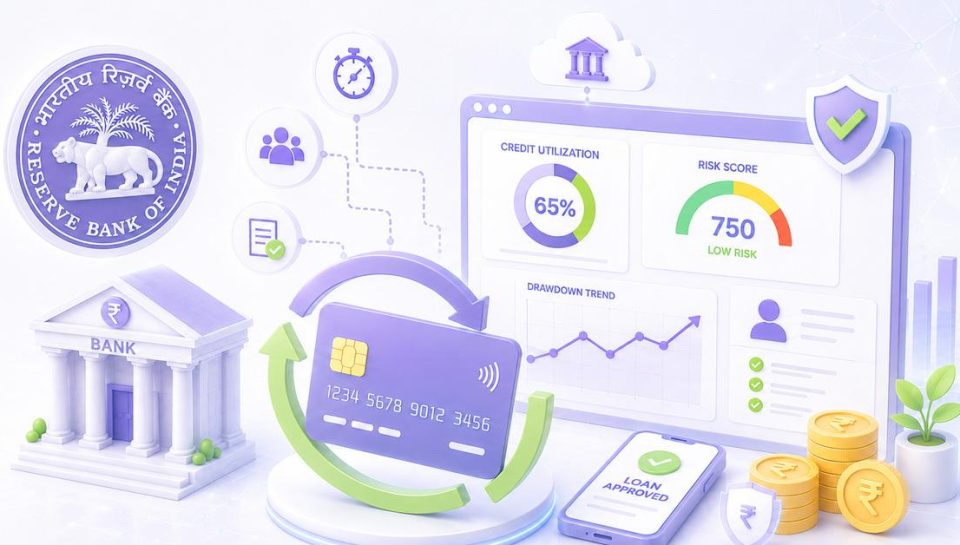
In recent financial industry news, the Reserve Bank of India (RBI) has actively sought feedback from non-banking financial companies (NBFCs) regarding proposed regulatory tightening on open-ended revolving credit lines.
As financial institutions expand retail and MSME lending, regulatory scrutiny around non-standardized debt products has intensified. Here is a granular breakdown of the central bank’s direction and its direct implications for recovery operations.
Decoding the Regulatory Shift: NBFCs Term Loan vs Revolving Credit

To evaluate the regulatory landscape, financial institutions must first address fundamental product distinctions: what is revolving credit compared to traditional amortizing credit? A revolving credit facility allows borrowers to draw down, repay, and withdraw funds continuously up to an approved credit limit without fixed repayment schedules. In contrast, the operational debate surrounding NBFCs term loan vs revolving credit, highlights that traditional term loans possess defined tenures, predictable EMI cycles, and explicit default triggers.
The RBI’s heightened vigilance stems from concerns over regulatory arbitrage and credit misclassification. When lenders structure ongoing credit facilities without stringent periodic review triggers or clear maturity dates, the risk of hidden stress and “evergreening” rises dramatically. Recent reporting from economic publications like The Economic Times (Source: ET BFSI) emphasizes that the regulator seeks to ensure revolving credit lines do not become conduits for masking non-performing assets (NPAs). Consequently, standardized risk profiling and strict compliance frameworks are moving from recommendations to mandatory operational pre-requisites.
Implications for Credit Risk Management in India
The central bank’s regulatory recalibration directly reshapes the broader architecture of credit risk management in India. Revolving lines, while offering flexibility to borrowers, introduce compounded risk vectors into retail and commercial loan books. Unlike fixed-term contracts, unmonitored drawdowns can obscure a borrower’s deteriorating leverage ratio until a sudden default occurs.
This systemic risk extends beyond core banking into consumer finance, fintech lending, and telecom post-paid billing structures. When borrowers utilize open credit lines across multiple NBFCs simultaneously, contagion risk spikes. If one lender restricts credit due to RBI compliance mandates, the sudden liquidity crunch can trigger cross-defaults across a borrower’s entire debt obligations—including telecom receivables and credit card balances.
Integrating robust monitoring tools into credit risk management in India is no longer optional. Collections and risk infrastructure must pivot from reactive delinquency management to real-time behavioral tracking. Monitoring drawdown velocity, credit utilization ratios, and multi-lender exposure in real time allows recovery teams to identify distress signals long before formal NPA classification occurs.
Re-Engineering Debt Collection and Recovery Strategies
The operational transition away from loosely governed revolving structures toward compliance-heavy frameworks creates distinct challenges for recovery and legal teams across lenders and utility providers:
- Data Harmonization Across Debt Categories: Recovery departments must bridge the gap between revolving credit metrics and fixed term loan recovery protocols. Data synchronization between originations, risk control, and legal recovery yields faster turnaround times and higher liquidations.
- Legal Enforcement Ambiguities: Enforceable legal remedies, such as Section 138, cheque bounce proceedings or SARFAESI actions, are straightforward under fixed EMI defaults. However, proving default events on a flexible revolving credit facility requires clear documentation of breach of terms, limit revocation, and formal demand notices. Legal departments must audit loan agreements immediately to ensure enforcement clauses hold up in court.
- Early-Stage Recovery Interventions: Because revolving borrowers often pay minimum amounts to maintain access to funds, traditional 30-day delinquency buckets miss early signs of distress. Recovery workflows must incorporate pre-delinquency triggers, contacting borrowers when utilization spikes without corresponding income verification.
Building an Agile Infrastructure for Regulatory Compliance and Recovery
The RBI’s push for structural transparency around the revolving credit facility model signals a permanent evolution in debt governance. Financial institutions and service providers can no longer afford to operate with fragmented risk and recovery silos. Navigating these regulatory shifts requires proactive alignment between underwriting standards, legal documentation, and collection operations.
Organizations that modernize their debt collection software ecosystem—by adopting automated risk-monitoring engines, updating contractual enforcement terms, and implementing data-driven recovery strategies—will maintain superior portfolio health and lower credit loss ratios. Now is the time to audit your credit line exposure, recalibrate recovery workflows, and deploy intelligent AI collection software and solutions equipped for strict regulatory compliance and maximum recovery efficiency.