
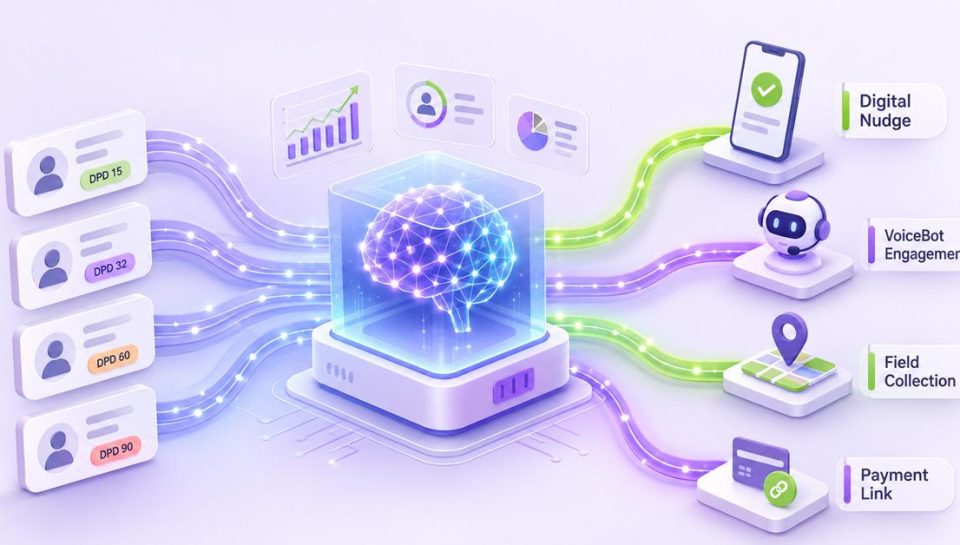
The BFSI and Telecom sectors in India today need an efficient AI debt collections software that could beat the mounting pressure on their recovery operations. As loan portfolios diversify and borrower profiles grow increasingly complex, top leaders in Legal, Collections, and Recovery departments are questioning the efficacy of legacy workflows. At the heart of this industry shift lies a critical question: what is the difference between rule-based collection automation and agentic AI in debt recovery?
While traditional automation operates on rigid timelines, today’s digital debt collection relies on real-time intelligence. Mobicule’s mCollect is pioneering this transformation by delivering end-to-end debt recovery using AI and predictive analysis. With the migration from a static, rule-based bucket formula to an advanced AI debt collections software, financial institutions can drastically reduce recovery costs, protect borrower relationships, and boost overall liquidity.
The Flaw in Static Rules: Why DPD Grouping Fails
For decades, the industry standard for collections has been a static, rule-based progression. The logic is universally familiar: a D-3 SMS reminder, a D+3 agent call, escalating to a D+15 field visit. However, grouping borrowers solely by Days Past Due (DPD) leads to poor recovery rates and misallocated agent bandwidth.
The fundamental flaw in this legacy model is its blindness to borrower intent and context. A serial defaulter who intends to evade payment and a loyal customer experiencing a temporary cash crunch are treated exactly the same if they fall into the same 30-day DPD bucket.
Consequently, rule-based systems trigger blanket outreach campaigns. This squanders valuable human resources on accounts that would have self-cured with a gentle digital nudge, while allowing high-risk accounts time to abscond. When macroeconomic headwinds spike delinquency volumes, these rigid parameters create operational bottlenecks, making it impossible to scale recovery efforts efficiently.
AI-Powered Debt Collections: Analyzing Data for True Intent
The transition from legacy systems to predictive collections software marks a shift from reactive penalty-chasing to proactive risk mitigation. According to recent industry insights on Agentic AI by Bottomline Technologies, modern autonomous systems allow prioritization to be intensely dynamic. Machine learning models analyze hundreds of behavioral data points—such as payment history, communication responsiveness, macroeconomic factors, and banking data—to predict default risk before it happens.
Instead of waiting for an arbitrary aging threshold, an AI debt collections software assesses the customer’s affordability and willingness to pay. By scoring the intent signals of a borrower, the platform segments the portfolio into micro-cohorts: those who need restructuring, those who simply forgot, and those requiring strict legal enforcement. This empathy-driven yet data-backed approach is the hallmark of modern digital debt collection, ensuring you recover funds without alienating salvageable customers.
Resolving Bottlenecks with Real-Time Multi-Agent Systems
Where traditional platforms create workflow bottlenecks, Mobicule’s mCollect resolves them. As an enterprise-grade predictive collections software, mCollect evaluates dynamic next-best-action (NBA) triggers and channel preferences in real time.
The platform immediately identifies the fastest route for swift recovery. Based on the AI risk profiling of each delinquent account, mCollect automatically assigns the precise communication channel—whether that is a frictionless SMS gateway, a conversational voice bot, or routing a complex settlement negotiation directly to a senior human agent.
By eliminating the manual IT interventions required to overhaul static rules, mCollect empowers banks, NBFCs, microfinance institutions, and co-operative banks to manage massive volumes dynamically. High-risk defaults are accelerated to specialized field or legal teams, while low-risk, high-intent borrowers are seamlessly managed via automated digital self-service.
Rule-Based Systems vs. Mobicule’s mCollect
To help decision-makers visualize the operational leap, here is a teardown of how traditional logic compares to mCollect’s real-time multi-agent ecosystem:
| Capability | Legacy Rule-Based Systems | mCollect – AI powered Debt Collections Software |
| Account Segmentation | Static, based strictly on Days Past Due (DPD) aging buckets. | Dynamic risk profiling based on intent, behavioral data, and ML predictive scoring. |
| Workflow Logic | Linear and rigid (e.g., D-3 SMS -> D+3 Call -> D+15 Field visit). | Real-time Next-Best-Action (NBA) adapting to borrower context and daily shifts. |
| Resource Allocation | High wastage; human agents cold-call low-risk and uncontactable accounts. | Optimized bandwidth; human agents only handle high-yield, complex negotiations. |
| Scalability | Severe bottlenecks during high-volume periods; requires manual IT parameter changes. | Instantly scales across diverse portfolios without requiring proportional headcount increases. |
| Customer Experience | Blunt, identical treatment for all borrowers, permanently damaging brand trust. | Contextual, empathy-driven outreach prioritizing preferred channels (WhatsApp, voice bot, email). |
Conclusion
The era of treating every delinquent account as an identical point on a DPD timeline is over. In a highly competitive BFSI and Telecom landscape, relying on static rules drains your margins, damages your brand reputation, and limits operational scalability.
Upgrading to an advanced AI collection software is no longer just an IT modernization initiative; it is a critical revenue-protection and increased efficiency strategy. Mobicule’s mCollect represents the forefront of this evolution, utilizing agentic AI to decode borrower intent, streamline resource allocation, and orchestrate the ultimate next-best-action for every single account.
Equip your recovery arm with Mobicule’s AI debt collections software – mCollect today, and transform your collections department from a cost center into a strategic, data-driven powerhouse.