

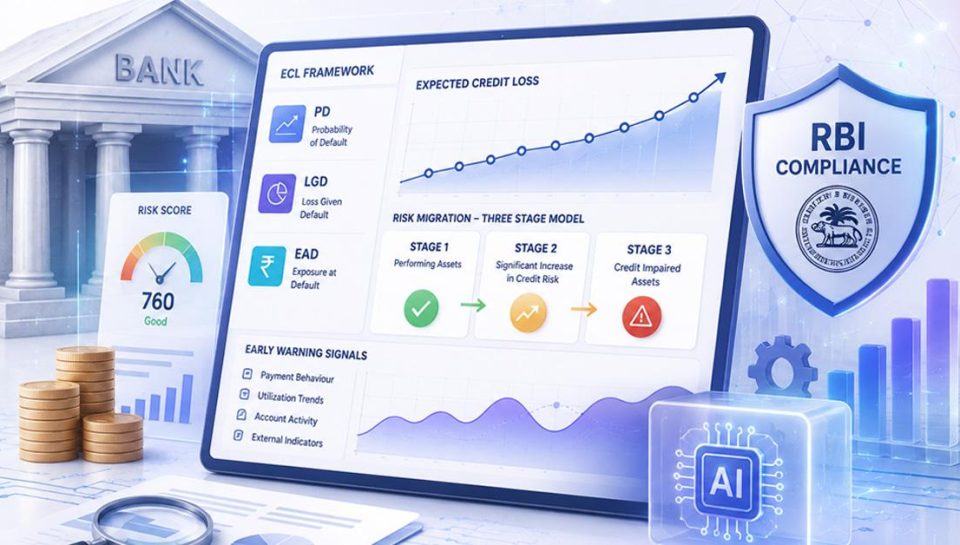
The ‘Expected Credit Loss’ Provision
The imperative for adopting Expected Credit Loss (ECL) provision is fundamentally driven by the strategic need to transition from a reactive “incurred loss” model to a proactive, forward-looking risk management paradigm.
By mandating the early recognition of credit deterioration, the framework compels financial institutions to evaluate core parameters—
a. Probability of Default (PD): The likelihood a borrower will not pay,
b. Loss Given Default (LGD): How much money the bank loses if a default occurs, and
c. Exposure at Default (EAD): How much money is at risk when the default happens.
This precise evaluation fosters transparent financial reporting while simultaneously building vital loss buffers early in the economic cycle, thereby protecting institutional capital from sudden depletion during systemic macroeconomic shocks.
April 27, 2026, marked an inflection point for the Indian financial sector. The Reserve Bank of India (RBI) published final directions formalizing the Expected Credit Loss Framework, permanently altering how Scheduled Commercial Banks handle provisioning and credit risk. Effective April 1, 2027, the mandate transitions the industry from a reactionary incurred-loss model to a proactive, forward-looking risk assessment protocol.
Decoding the Expected Credit Loss Framework
At its core, the Expected Credit Loss Framework requires financial institutions to calculate potential future losses by evaluating three critical metrics: Probability of Default (PD), Loss Given Default (LGD), and Exposure at Default (EAD). Instead of waiting for a borrower to cross the 90-day overdue threshold to be classified as a Non-Performing Asset (NPA), the ECL mechanism introduces a nuanced, three-stage asset classification system:
- Stage 1: Assets demonstrating no significant increase in credit risk. These require provisions based on 12-month expected credit losses.
- Stage 2: Assets showing a significant increase in credit risk since initial recognition, necessitating lifetime expected loss provisions.
- Stage 3: Credit-impaired assets, also requiring lifetime expected loss provisioning.
The new forward-looking Expected Credit Loss Framework also establishes strict prudential floors. For example, standard Stage 2 loans now attract a minimum 5% floor, ensuring banks maintain adequate loss-absorption capital.
According to a May 2026 insight report by KPMG International, implementing this framework requires robust governance and data infrastructure, compelling institutions to recognize credit stress well before it crystallizes into non-performing status. Although fundamental NPA rules remain unchanged, the expectation is undeniable: identify vulnerabilities early. This framework change spans across banking, corporate finance, and accounting sectors.
How ECL Guidelines Shift Focus for Collections
Historically, recovery operations in both BFSI and Telecom were heavily weighted toward post-default action. The ECL guidelines force a necessary paradigm shift. It is no longer solely about managing the drop-off; it is about managing the entire risk journey.
Be Proactive, Not Pre-NPA: The ultimate operational benefit of the Expected Credit Loss Framework is early recognition. For Telecom leaders managing massive volumes of postpaid receivables, utilizing an ECL-inspired approach allows for predicting default pipelines, minimizing churn, and deploying intervention strategies weeks before standard 90-day delays occur.
Track the Journey, Not Just the Stop: The ECL methodology is built on monitoring risk migration. C-Suite executives must ensure that collections teams track how an account moves from “healthy” (Stage 1) to “increased risk” (Stage 2) long before it hits Stage 3. It demands granular visibility into borrower behavior.
Signals Must Lead to Solutions: The data points feeding your ECL models are not just for the finance department; they are early warning signals for recovery agents. A platform-based approach can help banks to enable ECL provisions smoothly with the platform tracking their borrower delinquencies and ringing an alarm before the 90-day NPA risk, thereby eliminating human dependence or error and helping to make timely and sufficient provisions for the same. Monitoring is only the first step. The insights generated must drive systematic, structured escalation within your collections department.
Aligning Strategy with the Expected Credit Loss Framework
Integrating ECL into daily operations demands a seamless synergy between your Risk, Legal, and Collections departments. The RBI has permitted a transition period up until March 31, 2031, allowing banks to absorb the capital impact gradually. However, operational transformation must happen now.
Building a compliant and highly effective ecosystem under the Expected Credit Loss Framework requires much more than upgrading your IT architecture. C-Suite leaders must recalibrate their entire strategy. This involves retraining recovery agents to act on predictive signals rather than reactive triggers. Ultimately, under the ECL guidelines, data must flow instantly from risk identification algorithms straight to the collections floor, triggering tailored, empathetic customer interventions that prevent accounts from ever reaching Stage 3.
Conclusion
The transition to the Expected Credit Loss Framework represents an unprecedented opportunity to optimize your recovery operations, protect capital, and fortify your balance sheet. The new ECL guidelines are far more than a regulatory hurdle; they form the bedrock of a proactive, resilient, and intelligent collections strategy.
As the 1st April 2027 compliance deadline draws nearer, complacency is simply not an option for BFSI and Telecom leaders. Equip your workforce, invest in predictive data infrastructure, and begin transforming your pre-NPA strategies today.


