
The Indian credit landscape has witnessed a structural surge toward asset-backed retail Microfinance in India. According to recent credit bureau data published in the Equifax Microfinance Pulse (June 2026), the industry’s Portfolio Outstanding (POS) rebounded to over ₹2.77 Lakh Crore, propelled by a distinct migration toward higher average ticket sizes (loans above ₹75,000 now accounting for over 41% of origination value).
While asset quality has stabilized—with PAR 30+ delinquency moderating significantly across primary lending hubs—managing operational overhead in high-density, low-margin micro-portfolios remains a board-level imperative for banks, SFBs, and NBFC-MFIs.
Deploying an enterprise-grade digital debt collection platform for MFIs is no longer merely a channel optimization project; it is the core operational lever to lower provisional cost levels, enforce strict RBI compliance standards, and drive collection efficiency ratios beyond 98%.
The Structural Bottlenecks in MFI Debt Recovery
Microfinance collection leadership across India’s core financial hubs faces three persistent operational bottlenecks:
1. Inefficient Field Agent Allocation and High Friction
Traditional MFI operations rely heavily on manual assignment of overdue accounts to field supervisors following missed center meetings. Without intelligent clustering and real-time route optimization, field officers spend up to 40% of their day traveling between disparate locations rather than engaging borrowers, severely depressing daily contact rates.
2. Regulatory Risk Under RBI’s Fair Practices Code
With strict RBI guidelines governing recovery agent conduct, contact timing, and borrower communication protocols, microfinance institutions face massive reputational and regulatory penalties for non-compliant outreach. Manual call centers and unmonitored field staff lack real-time compliance controls, creating blind spots in governance.
3. Cash Handling Hazards and Delayed Reconciliation
Despite the rapid adoption of digital payments in tier-2 to tier-4 regions, cash remains a dominant mode of payment in micro-loan centers. Paper-based receipts and delayed end-of-day bank deposits introduce audit discrepancies, heighten field safety risks, and stall real-time updates to Core Banking Systems (CBS).
Modern Digital Architecture for Early-Bucket Resolution
To systematically elevate collection efficiency, top executives must replace fragmented legacy point-solutions with an integrated, API-driven architecture that standardizes debt recovery workflows from early engagement through field completion.
Strategic Operational Capabilities
Embedded Compliance Governance: Built-in safeguards enforce call timing restrictions, log communication consent, and create an unalterable audit trail required for regulatory reporting.
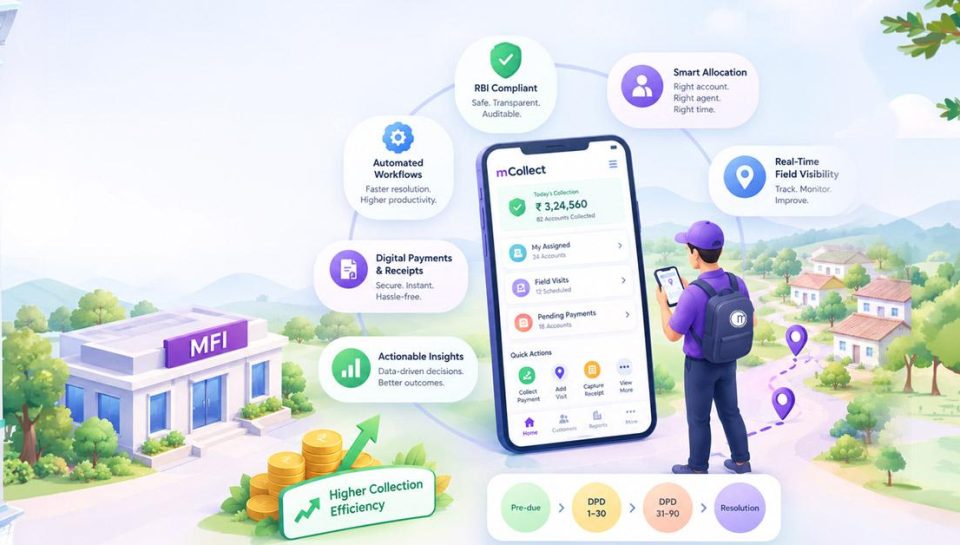
Dynamic Risk-Based Allocation Engine: Automatically categorizes overdue accounts into pre-due, DPD 1–30, and DPD 31–90 buckets. Accounts requiring high-touch intervention are immediately routed to nearby field agents via geotagged mobile schedules, while low-risk accounts receive automated digital reminders.
Offline-First Field Mobile Application: Engineered for low-connectivity rural pockets, enabling agents to collect payments via dynamic UPI QR codes or physical cash, generate instant digital receipts, and sync data seamlessly upon reconnecting to network towers.
Comprehensive Agency Governance: Provides institutional lenders with real-time dashboards to track outsourced recovery partner performance, SLA compliance, and automated commission calculations—ensuring complete agency control across wide geographical footprints.
Modular Operations Beyond Repossession and Settlement
For microfinance portfolios, traditional recovery mechanisms such as asset repossession or heavy legal settlements are economically non-viable given the average ticket size of micro-loans (typically ₹30,000 to ₹70,000). MFIs require a proactive, pre-litigation architecture focused on operational throughput, dynamic allocation, and field workforce enablement.
An enterprise modular stack—such as mCollect by Mobicule—redefines this operational engine by isolating core collection execution modules:
- Smart Allocation & Workflows: Automatically segmenting borrowers based on repayment behavior, geographical cluster, and delinquency propensity, ensuring the right account hits the right field agent or tele-calling queue on Day 1.
- Agency & Partner Management: Providing complete, real-time visibility into third-party agency performance, fee reconciliation, and strict audit trails to eliminate leakages.
- Field Collection & Agent App: Equipping collection personnel with multi-lingual, offline-capable mobile workflows that issue instant digital UPI/cash receipts, eliminating cash reconciliation delays and manual entry fraud.
- Digital Debt Resolution & Omnichannel Engagement: Engaging borrowers natively via automated WhatsApp nudges, Interactive Voice Response (IVR), and regional language SMS reminders prior to or immediately upon missing a Joint Liability Group (JLG) center meeting.
By bypassing the friction of manual asset tracing or settlement negotiations, these core operational modules directly optimize early-bucket (0–30 DPD) resolution rates while preserving long-term borrower relationships.
Conclusion: Transforming Debt Recovery into a Strategic Growth Driver
In an era of expanding average ticket sizes and heightened credit risk scrutiny, microfinance institutions cannot afford the operational drag and compliance risks of legacy collection practices. Elevating portfolio yield requires an intelligent, automated, and human-centric operational framework that acts long before an account degrades into default.
By deploying an enterprise digital debt collection platform for MFIs, forward-thinking BFSI leaders can systematically reduce early-stage rollover rates, maximize field workforce productivity, and enforce uncompromising regulatory compliance across every borrower touchpoint.
Explore Mobicule’s mCollect today to schedule a strategic demonstration with our BFSI domain experts.